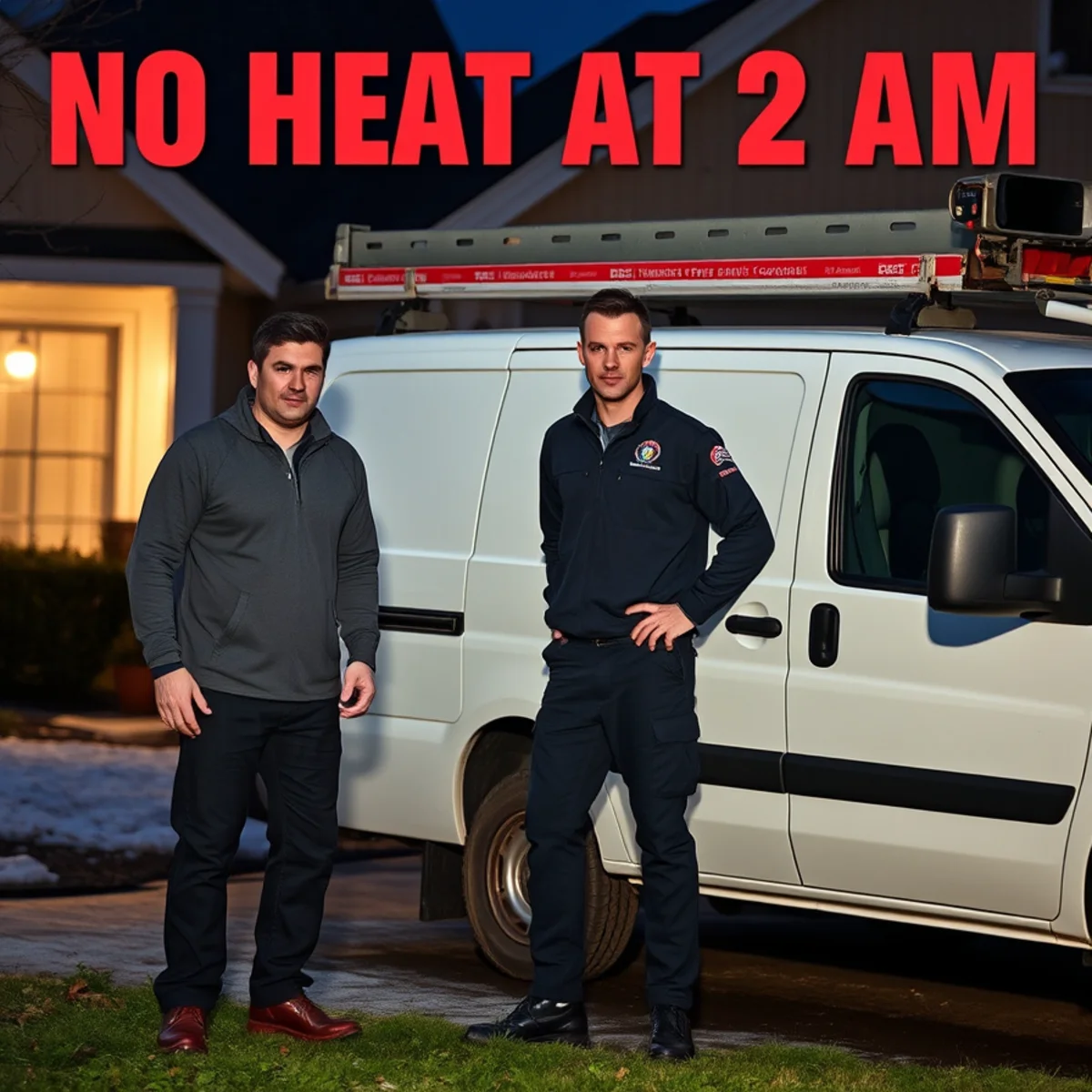

A dead furnace on a January night is more than an inconvenience — it is a health and safety issue for children, older adults, and pets, and it can put your pipes at risk. We answer no-heat calls day and night and work fast to restore heat safely.
If you smell gas or suspect carbon monoxide, leave the house now and call 911 or your gas utility before anything else. Do not restart a furnace that keeps tripping — call us to diagnose it safely.
Why furnaces fail on the coldest nights
The hardest freeze is exactly when a marginal part gives out — a tired igniter, a dirty flame sensor, a frozen or blocked condensate line on a high-efficiency unit, a pressure-switch fault, or a tripped high-limit from restricted airflow. We carry the common failure parts so many no-heat calls are fixed on the first visit.
What to do before we arrive
- 1Confirm the thermostat is set to Heat and the set point is above room temperature.
- 2Check whether a breaker tripped or the furnace switch got bumped off.
- 3Replace a visibly filthy filter — then stop troubleshooting if the fault returns.
- 4Keep everyone warm and safe; use space heaters only well clear of anything flammable.
- 5Photograph any blinking error codes on the furnace for the technician.
Protecting your pipes and your home
A long no-heat stretch in deep cold can freeze pipes and cause expensive water damage. If heat will be out for a while, we will advise you on protecting vulnerable plumbing — and we also offer dedicated frozen pipe & heat outage response. For the full playbook, read What to Do When Your Furnace Quits on a Mechanicsburg Winter Night.
What no-heat calls cost
We prioritize no-heat calls and disclose any after-hours rate on the phone before dispatch. The diagnostic (about $85 in the area) is often credited toward the repair, and because the coldest-night failures are usually a tired igniter, a dirty flame sensor, a frozen condensate line, or a pressure-switch fault, we carry those parts and fix most calls on the first visit — restoring heat fast rather than scheduling a return trip in the cold.
Why choose HVAC Mechanicsburg PA when the heat is out
A dead furnace on a January night is a health and safety issue for children, older adults, and pets, and it puts your pipes at risk. We treat it that way — prioritizing dispatch, walking you through staying safe and warm on the phone, and diagnosing the fault properly instead of just clearing a lockout that will trip again. It is the responsive, honest standard behind our 4.9-star rating across 187+ Cumberland County reviews.
- No-heat calls prioritized, especially with infants, elderly residents, or freezing indoor temps
- Common failure parts stocked for first-visit restoration of heat
- Guidance on protecting vulnerable pipes if heat will be out for a while
- Straight talk if a repeated fault points to a safety issue or end-of-life furnace
Staying safe and warm until we arrive
While you wait for a no-heat call, a few steps keep everyone safe and protect the house. Confirm the thermostat is set to heat above room temperature and that the furnace switch and breaker were not bumped off — occasionally that is the whole problem. Keep vulnerable occupants warm with layers and blankets, and if you use a space heater, plug it directly into the wall (never a power strip), keep it at least three feet from anything flammable, and never leave it running unattended or overnight. Close off unused rooms to concentrate what warmth you have.
In a hard freeze, open cabinet doors under sinks on exterior walls and let a trickle run from the most vulnerable faucet so pipes do not freeze while the heat is out. And resist the urge to keep resetting a furnace that keeps locking out — that lockout is a safety response to a real fault, and repeatedly overriding it can mask something dangerous. Shut it off and let us diagnose it properly.
When repeated no-heat calls mean it’s time
One isolated failure on an otherwise reliable furnace is worth repairing. But when a furnace starts stacking up no-heat calls — an igniter this month, a control board the next, a pressure switch after that — the repairs are telling you something, especially on a unit past 15 to 20 years. We keep you running through the emergency, then give you the honest repair-vs-replacement math: the cost of this fix, the age and condition of the system, and what a right-sized modern furnace would cost and save. You make the call with real numbers, on your timeline, rather than replacing under pressure on the coldest night of the year.
A dead furnace is hardest on infants, older adults, and anyone with a health condition, so do not tough it out overnight hoping it resolves — call and let us give you a real arrival window. Getting heat restored quickly also protects your pipes before a hard freeze turns a no-heat call into water damage.
No-heat coverage across the Mechanicsburg area
We answer no-heat emergencies around the clock across Cumberland County, from the older-furnace stock in Downtown Mechanicsburg and East Portland to the townships of Upper Allen and Monroe, where floodplain crawlspaces make frozen pipes a real risk. See also our frozen pipe & heat outage response.